It seems pretty clear that a rigid binary classification of societies in to settled/agricultural and nomadic/hunter-gatherer is false.
For example: What constitutes a settlement anyway? Just how long does it need to be in use before it's a settlement instead of a camp? Does regular seasonal use constitute permanence? In many hunter gatherer societies agriculture is documented. What about if shelter is natural (rock shelter), mobile (yurts or boats) or unnecessary (good weather)?
This is all part of a general ancient history rethink that I think it's fair to say is going on. We've figured out that ancient history is far more nuanced than many 20th century Western history scholars gave it credit for, and modern archaeology and genetics in particular are only now showing us the scale of our misconceptions.
Example areas of complete rethink: peopling of the Americas, continued diversity (and interbreeding with) non-homo-sapiens, speed and breadth of human diffusion, speed and breadth of technology invention and diffusion in pre-historic peoples.
First of all, this finding can be incorrect. It can be misdated, they may have made a mistake about the grain being processed into bread.
Even if they are 100% right, it doesn't really upend anything majorly. It just means what it says - hunter-gatherers turned the grains they gathered into bread 5000 years earlier than we thought. Any how, the Natufians and Chinese are thought to be the first two cultures to become agricultural.
What you're talking about is 20/20 hindsight. You're living in a world with self-driving cars and Mars space probes and croissants and corn and looking back with that lens. There were innumerable barriers entering into agriculture (and not only barriers, but most hunter-gatherer bands preferred roaming around their territory as opposed to remaining in one place all the time and doing the same thing every day).
We did not have corn and wheat and domesticated animals and oxen and crop rotation. Infectious diseases were as much a problem as when the New World's indigenous societies encountered Europeans.
Anthropologists say the Neolithic revolution was dramatic because it was dramatic. It was a complete transformation of society - more socially transformative than anything that has happened in the past 30000 years.
>It seems pretty clear that a rigid binary classification of societies in to settled/agricultural and nomadic/hunter-gatherer is false.
Here's the problem, there's an established 'story' and if someone tries to go against that established 'story' about human history, they will find themselves unemployable. They will not be permitted to be a part of digs, they will not be able to find grant money, they will not be able to find a university that will take them in.
If someone finds something that even adds doubt it's immediately labeled a misinterpretation, a fake, some natural process that resembles human activity etc.
Add to that if you go back to Toba supervolcano 70,000 years ago you wipe out most of the human population at the time with some estimates getting you into a few thousand humans across the entire planet which obviously could have ended societies that did exist at the time and were not nomadic, if they were using largely grass and wood for their construction, a supervolcano erupting could have quickly led to using construction materials for heat source, as a source of food for any animals that were struggling to find food etc. Even small settlements spread out might go undiscovered by archaeologists for centuries.
If you look at Kenya’s Olorgesailie Basin there's potentially evidence of tool building 320,000 years ago. That right there kinda takes everything and goes "yeahhhhhhhhhh we're probably wrong" https://www.popularmechanics.com/science/archaeology/a194478...
Telling me we had tools 320k years ago but we didn't figure out agriculture until 12-14k years ago? Heh. Ssssssure.
I urge anyone to go read about the history of archaeology, it's only until extremely recently (the mid 1900's) that it even started to become a proper science and even then most of the labor was untrained volunteer and many an important site were discovered by people native to the area before properly trained people were notified and brought in.
Even recorded history is extremely suspect until very modern times. Some will argue it didn't become reliable until the 11th-12th century but we still see instances of stuff unreliable past that. Some firmly believe Joan of Arc is a fabrication for example, which calls 15th century 'history' into question... when someone questions her existence with logic they are quickly called a 'revisionist' and considered a nutjob though.
The fact that 'revisionist' and 'historical revisionism' exist as concepts are troubling because they are often used disparagingly of anyone that questions the 'official story' where in other disciplines it would be considered healthy skepticism.
> there's an established 'story' and if someone tries to go against that established 'story' ... they will find themselves unemployable
Absolute baloney, if you were a little older you might realize that "the stories" are, in fact, constantly updated and revised which is how we would expect science to work. In this case there is other support for earlier agriculture (e.g. Tell Abu Hureyra) and the people involved in that work are hardly "unemployable":
> They will not be permitted to be a part of digs, they will not be able to find grant money, they will not be able to find a university that will take them in.
That's demonstrably false. Here are a few counterexamples:
These are all researchers that argue that cultivation occurred much earlier than the 10-12k year ago date commonly given, and was often done opportunistically by hunter-gatherer groups.
>The fact that 'revisionist' and 'historical revisionism' exist as concepts are troubling...
Historical revisionism usually refers to re-writing history on ideological grounds, i.e. "it would better suit my interest group if people thought it happened this way," or more insidiously "it confirms my belief system if it happened this way." That's why it exists as a concept, if someone is questioning the norm on the grounds of archeology and they get called revisionist that's just a misapplication of the term.
Even recorded history is extremely suspect until very modern times.
On the flip side, in ancient Chinese history it has been quite amazing to see how much detail preserved in written form has very recently been validated through archaeology. One major example was the 1980s discovery of the Shu kingdom: https://en.wikipedia.org/wiki/Shu_(state)
Is your comment supporting the idea that Joan of Arc did not exist? Because that would be a bold claim to make when there is so much evidence about her deeds across several sources that nobody seriously refutes.
>Is your comment supporting the idea that Joan of Arc did not exist?
I think someone may have, but a lot of the accounts of her were likely patriotism. From what I've read people from Domremy didn't much care for the French so why would she go to war for them for example.
There are several historical figures that are likely largely inflated like Shakespeare, Fulk FizWarin (Robinhood), William Tel, Sun Tzu, Faust (appears there were two different guys operating a decade or two apart going by the name), Pythagoras, Lycurgus, (obviously) Socrates.
Then you have famous 'things' like the 'Marie Celeste' which didn't exist although the 'Mary Celeste' did and stories about both are widely accepted as largely incorrect.
Some of the first blatant, and widely accepted, 'fake news' was in the 1800's with the Great Moon Hoax https://www.wikiwand.com/en/Great_Moon_Hoax , Joseph Pulitzer basically started the Spanish-American War with 'news'.
that Joan of Arc s character may have been used for various means and inflated is pretty much obvious, but denying her existence is honestly hard to support when even her enemies recorded facts about her.
> Telling me we had tools 320k years ago but we didn't figure out agriculture until 12-14k years ago? Heh. Ssssssure
I think you misunderstood the problem. It's not about "figuring out" agriculture, it's about finding a reason to do it. There's nothing obviously benefitial in staying in one place and working just as hard if not harder.
> Here's the problem, there's an established 'story' and if someone tries to go against that established 'story' about human history, they will find themselves unemployable.
Are you really dismissing an entire academic discipline because you believe everyone in it is collectively either dishonest or insane?
This is the sort of reasoning that leads people to dismiss climate change or vaccination as grand conspiracies against the public. Huge claims require huge evidence. To entertain your claim I would expect you to produce not one but mountains of sources. Otherwise you're basically dismissing all of anthropology and archaeology as fake? What's more likely, given the evidence, that every academic professor is a nutjob or that you're wrong?
Have any good reads on this? Sounds like granting agencies and science funding in general are favouring a specific story about human history, but would like to read more.
You should step in to this hunt knowing that the shelves are downright sagging under the weight of hundreds of off-the-mainstream books that are incredibly convincing on their own but contract each other when put together. Writing a story that makes sense is the domain of novelists, and writing a story that passes through a few verifiable points on its winding way is only a little different in practice.
There are some common historical inaccuracies in this article, like the fact we were taught Columbus discovered America as recently as the early 90's in my case (class of '13) despite them knowing damn well he didn't, Newton and gravity, how slavery is conveniently never mentioned in the North, etc https://www.thisisinsider.com/myths-lies-learned-in-school-w...
For Columbus in-particular the Oatmeal did a decent, but over the top, write up some years back http://theoatmeal.com/comics/columbus_day I was literally taught in the early 90's that they believed the earth was flat and that Columbus was brave enough to attempt to sail to India and that everyone thought he was crazy and would fall off the side of the world. This was in a public school, 20 something years ago. Yet we know there were colonies, that were eventually abandoned, and one was found in the 1960's in Newfoundland.
Hell look to certain countries in the middle-east and there are millions that flat out think the holocaust never happened, people the world around that think the moon landings were on a sound stage, people trying to currently change history with the 'Mandela Effect' (Berenstein or Berenstain Bears?).
As far as people being blackballed, that's mostly just people coming forward after they allege it has happened or refusing to be part of something for fear of it although you can go read a lot about Zahi Hawass https://www.wikiwand.com/en/Zahi_Hawass and see where he was pretty damn nutty about creating his own narrative of Egyptian history for example
"Hawass has been accused of domineering behaviour, forbidding archaeologists to announce their own findings, and courting the media for his own gain after they were denied access to archaeological sites because, according to Hawass, they were too amateurish."
Zahi also strongly fought against any western archaeologists that wanted to question the timeline for the great pyramid and the Sphinx, flat out refusing their entry into the country in some instances and like when they drilled through the 'hidden door' in the great pyramid after jumping through all kinds of hoops and finding another door not farther up he flat out refused to let them drill through it.
I also recall Zahi having hieroglyphics at one site, that there are black and white photos of, covered in plaster but I can't seem to find what site it was. I distinctly remember seeing side by side photos, the period black and white next to a modern photo showing extensive plasterwork having been added, allegedly to 'protect' the site (bit weird, no other archaeologists seem to do that at ancient sites).
> I was literally taught in the early 90's that they believed the earth was flat and that Columbus was brave enough to attempt to sail to India and that everyone thought he was crazy and would fall off the side of the world
You do realize this was simply bad teaching, right?
The ancient Greeks knew the world was round. The objection to Columbus‘s voyage was that the world was probably too large, and hence the ocean too wide, to cross in a sufficiently short period of time. He drew upon some dubious calculations of the size of the world in order to get his exploration funded.
Update: to be clear, absolutely there would have been people who thought they’d fall off the edge of the earth. There are always uneducated people, presumably large numbers in the 15th century.
Primary/secondary textbooks are not professional academic publications, and typically lag far behind the latter. Your primary/secondary teacher's behavior is not a reflection of professional archaeologists' behavior.
It seems pretty obvious that what we know about is the barest sliver of what was actually going on tens of thousands of years ago. If nothing else, look at historical sea levels through the fluctuations caused by the ice ages. Vast areas that are currently at the bottom of the oceans were dry land, most famously the Bering land bridge and Doggerland, but huge, huge areas all over the world.
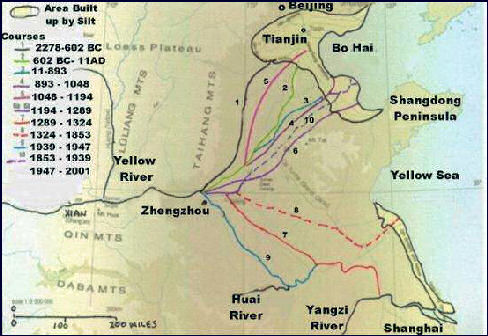
Even in recorded history, terrain is much more malleable than you might expect - rivers changing their course, sometimes wildly, is not especially uncommon. For instance, it is well attested that the Yellow River has changed course such that it has reached the sea both north and south of Shandong in various eras.
"It seems pretty obvious that what we know about is the barest sliver of what was actually going on tens of thousands of years ago."
It doesn't seem to be obvious to most highly educated people I know. From their perspective, the history of humanity might as well be only 5,000 years old, they rarely open up to any kind of interest in the fact that ancient civilizations from 3K-5K BC considered _their own civilizations_ to be degraded forms of much earlier civilizations.
It is also completely off the boards to discuss the potential of rapid techtonic shifts periodically erasing human societies. There are quite a few underwater cities in ruins, and of course myths and legends of even larger ones. But they don't get much play.
>There are quite a few underwater cities in ruins, and of course myths and legends of even larger ones. But they don't get much play.
Indeed, the tsunami back in what 2005 revealed ancient ruins out underwater, carved animals and a temple when the water receded. An entire city, right there in front of their noses, only revealed when a massive tsunami caused the water to recede temporarily.
> ancient civilizations from 3K-5K BC considered _their own civilizations_ to be degraded forms of much earlier civilizations
That is fascinating. Which civilizations were these, and where can I read about them? Did they think that because there were civilizational collapses earlier in human history?
Dan Carlin references A.T. Olmstead in describing how the ancient world believed had eras of its own antiquities. It begins by referencing an event in 500 BCE but then proceeds to move further back in time. It's in the first King of Kings episode, with context starting at around 32:00 and the quote starting somewhere after 33:30.
Now, this same list says that these individual rulers lived for thousands of years. Obviously that is something of a red flag in terms of applying this list literally.
To me, though, it raises a lot of questions.
In conversation, however, it usually goes nowhere.
The 3K-5K is extrapolated based on the time spans of the claimed length of these civilizations but I should clarify that most of the writing about how the ancient world viewed itself comes from after 2K and especially after 1K.
The "biblical" (bad word for it, considering how ubiquitous it is as a legend world wide) flood fixtures prominently as a moment of civilizational collapse.
The tricky part is how to interpret the multi-thousand year "reigns" of the "gods" that supposedly came before that.