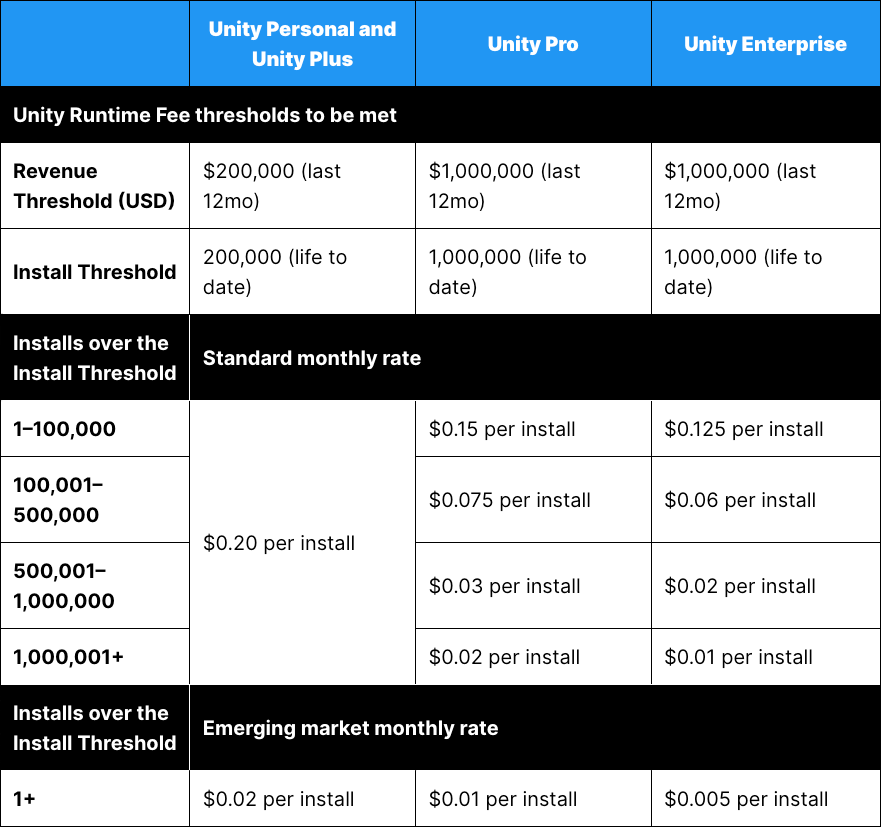
I don't understand, is this as absolutely insane as it seems? Am I reading this wrong? They're charging the game developer 20 cents every time a user installs the game? I must be missing something here.
Yes, but the developer has to have made $200k over the last 12 months and had 200k installs. So if you hit both minimums and have made $1/install, they'd like 20% of that. Unless you're in an emerging market, in which case it's 2%.
Is that insane? I'm not a game developer, but it seems like it's in the ballpark of what the app stores are charging, and with a structure that's actually enforceable at reasonable cost from Unity's perspective.
> it seems like it's in the ballpark of what the app stores are charging
Are there any app stores that charge developers per install? It's only per-purchase/transaction, right? The principle behind that is you don't get charged except as part of a transaction where you're making money. If a user downloads your app for free or pirates it or doesn't make any transactions, you don't pay anything.
What Unity is saying that if I buy a new phone and re-download my apps, that should cost the developers money. That seems like a very different situation to me.
I get the concern, but app stores can do that because the money flows through them. Unity says they're shifting away from revenue shares, presumably because they can't track purchase revenue and are tired of having a bunch of small fights with people who have every incentive to hide revenue from them.
> presumably because they can't track purchase revenue
So tracking installs and distinguishing between pirated and legit copies, and fingerprinting consumer hardware, and dealing with malicious or troll installs is going to be something they're somehow better at?
I can't prove Unity's motivations, but I can quote directly from their article:
> Qualifying customers may be eligible for credits toward the Unity Runtime Fee based on the adoption of Unity services beyond the Editor, such as Unity Gaming Services or Unity LevelPlay mediation for mobile ad-supported games. This program enables deeper partnership with Unity to succeed across the entire game lifecycle. Please reach out to your account manager to learn more.
and I think it's reasonable to at least entertain that it's not enforcement trouble that's causing them to create this policy. Not for the least reason being that they still have a revenue requirement sitting in front of this policy, and they still need to engage in the exact same accounting and fights to figure out which companies have made $200,000 so they can start charging them per-install.
I have no inside knowledge and am not a game developer. So I'm just guessing here. But yes, I believe tracking installs, which have published app store numbers and are instrumentable by them, is much easier than tracking revenue.
Note that nobody here really cares about total precision. Especially not their major customers who have negotiating power and who end up paying $0.01 per install. They're going to miss x% of the installs and have y% of spurious extras, and whether or not this approach advantages one side or the other is going to depend on a lot of factors down in the noise. If there's a large enough error it's going to end up as one more factor in the conversation with the account rep I'm sure they'll be having anyway.
> they still need to engage in the exact same accounting and fights
No, I think these are very different fights. A rev share means that every month everybody has to have the fight about what the actual revenue numbers are. I expect the way this work is that Unity will be tracking every game and looking at their app store metrics. If in their opinion they think you're making enough money to be worth squeezing, they're going to have an account rep call you. And if you don't engage, eventually they bring in the lawyers. So it's a one-time pain versus a monthly pain. Then the fight's just about install numbers, which are published and which I'd guess they have the ability to check on via instrumentation.
I disagree, these requirements refresh regularly and are applied per-game (note, I'm not saying that Unity is charging per-month, I'm pointing out that if you make $200,000 one year and $180,000 the next year, you dip back under the threshold and don't have to pay.)
This is still going to be a continual fight. Sure, I buy that you save some effort for studios that are clearly over the threshold, but it sounds like you're primarily talking about smaller companies anyway, and (correct me if I'm wrong) I don't see how it would be harder for a company to say "last year our 5 games each only made $190,000, it was a slow year for us".
> They're going to miss x% of the installs and have y% of spurious extras, and whether or not this approach advantages one side or the other is going to depend on a lot of factors down in the noise. If there's a large enough error it's going to end up as one more factor in the conversation with the account rep I'm sure they'll be having anyway.
> Then the fight's just about install numbers, which are published and which I'd guess they have the ability to check on via instrumentation.
I don't think these statements agree with each other. In any situation where it's simple to check install numbers (ie, Steam) -- Steam will also be tracking revenue. Where sales numbers are hard to track would be across multiple storefronts where... I mean, installs are also going to be hard to track. Unless they're planning to require an Internet connection for installing GoG games and Itch games because those installs aren't otherwise tracked. But I feel like that's going to be an issue for users if they do. Tracking revenue on a platform like GoG should be significantly easier than tracking installs, GoG has very little infrastructure I'm aware of to track installs of DRM free games.
I'm not an accountant, I don't want to make a serious claim, I could be wrong about the complexity, but it sounds like there is still going to be fighting over what installs failed, what was and wasn't pirated, etc... is that fight easier to have than "how much revenue did you take in?" :shrug:
Also bear in mind that this is not "you cross the threshold and then pay us for all installs", it's "you cross the threshold and pay us for installs after that point." So it's not just enough to ask if a company is making $200,000. When did they hit $200,000 in the current calendar year? How many installs happened specifically after that point? You still have to have that conversation with the company's accountants and you still have to try and confirm dates. And you have to do that yearly, and if you're already going to companies yearly and working with their accountants per-game to figure out when exactly installs start costing money... I don't know, again I'm not an accountant. I see that as a similarly complicated problem. Maybe I'm wrong.
----
My take is that Unity isn't saying that this makes their accounting easier, they're saying that it's going to encourage more "deep collaboration" with developers who purchase additional services, and that it supports the "continued investment" of the runtime. I'm inclined to believe the motivations that they're saying publicly. I'm sure that if they're pressed they won't reject a framing of accounting/ease of use, but it strikes me that it's not the motivation they're leading with. But I can't read their mind.
The FAQ suggests that once you cross the install threshold, you keep paying. The thresholds are "lifetime"
>The Unity Runtime Fee will apply to this game, as it surpasses the $1M revenue and 1M lifetime install thresholds for Unity Pro. Let’s look at the game’s installs from the last month:
Prior month installs (Standard fee countries) - 200K
Prior month installs (Emerging market fee countries) - 100K
The fee for install activity is $23.5K USD, calculated as follows:
(100K x $0.15 (first tier for standard fee countries)) + (100K x $0.075 (second tier for standard fee countries)) + (100K x $0.01 (fee for emerging market countries)) = $23.5K USD
Wait, that can't be right, it would be ludicrous. Once a game passes the threshold it pays per-install permanently? That's so wildly horrible of a pricing model that I just have to assume that's not what they intend, even a completely out-of-touch exec should be able to see the problems with that.
Have a game that's profitable enough to pass the threshold and then interest drops off? You're suddenly incentivized to completely take it off of the market and remove the game from people's libraries since you'll keep racking up fees from installs even if no one ever buys another copy.
I'm not denying that the quote does seem to imply what you're saying, but I have to believe that's a misprint or bad writing on their part, the implications of the threshold being lifetime sales are so bad. The policy is bad, but there's no way Unity is that comically out of touch, is there?
> Wait, that can't be right, it would be ludicrous. Once a game passes the threshold it pays per-install permanently?
Yes and no. You need to meet _both_ thresholds, cumulative (lifetime) installs _and_ yearly(!) revenue. I (!)'d the yearly part there, because you still need to be pulling in a yearly $1M of revenue (I'm assuming Unity Pro here cause the math is simpler) after your 1M of installs.
So while there are some edge cases here that are legitimately ludicrous, it's not the case that you're on the hook for the game in perpetuity, because if your game falls off a cliff and you make $500k in revenue next year, you owe nothing in runtime fees. In other words, you're not incentivized to take it off the market after 1M installs unless the runtime fees made it so you started losing money on the game after your $1M of revenue-- there are some examples where this is possible but none of them are very realistic.
It's also not clear if its $1M in the previous 12 months, or in the past calendar year, or if they have any rights to audit us, or which financial entity is on the hook. Is in the entity that pays for Unity, or the Publisher, or the Distributor?
What about the contractors we pay to do a few months of work at the end and use their own licenses. What about the folks that do our PS5 and Xbox ports for us?
Unity attempted to clarify their position around Game Pass telling devs not to worry because Microsoft will pay, but that makes me more worried because MS will just pull those games. I think there are 25 million Game Pass subscribers, and that's a lot of 20c installs.
We were hoping for another stint in Game Pass as a follow up to Void Bastards.
their terms also not about game profits. Let's say in case if $300k spent on Ads to get 200k+ installs and as result you made only $200k back as in-apps payments Revenue from game (so your profit is loss of $100k+fees+taxes) then Unity will demand you to pay them $40k+ just to cover installs amount and you almost won't have control to stop new charges because even if you will shutdown a game then some installs continue to happen from various pirate sources or some small app stores.
It looks completely insane terms for lot of mobile games where monetization is huge challenge and difference between profitable game and company bankruptcy measured in cents per user.
> Unity says they're shifting away from revenue shares, presumably because they can't track purchase revenue and are tired of having a bunch of small fights with people who have every incentive to hide revenue from them.
So now they are charging developers for something users have an incentive to try to do without paying the developer.
I would not categorize an ad platform as an app store. Plenty of streaming services and content licensing models charge per-stream/impression as well, but I feel that's a pretty separate category.
I'd be open to more clarification if there's something I'm missing, but I still don't think this is comparable to app store fees.
Do stuff like DDoS attack services or botnets charge per-install instead of directly for usage or compute time? Honestly kinda predatory pricing if that's the case. Seems a little problematic.
> it seems like it's in the ballpark of what the app stores are charging
But now that's on top of the app store fee. So, using your example and the "standard (aka 30%)" app store fee, after that 200k cliff, the game makes $0.50 for every $1 sale. That is going to drive people away from using Unity on mobile games imo. Who cares about a $0.20 fee for a $70 (rip $60) game, but for a $1 game where 30% of your rev is already gone... it changes the dynamics.
Maybe that's what they want though? Maybe they are trying to use this to angle as Unity is a "serious" engine now?
Yeah, the case that interest me is mobile games with a high install/revenue ratio. If I install a popular game, try it out for 3 minutes, and decide it's not for me, then am I costing some indie developer $0.20 even though there's no revenue?
My guess is that the answer there is in this bit: "Qualifying customers may be eligible for credits toward the Unity Runtime Fee based on the adoption of Unity services beyond the Editor, such as Unity Gaming Services or Unity LevelPlay mediation for mobile ad-supported games. This program enables deeper partnership with Unity to succeed across the entire game lifecycle. Please reach out to your account manager to learn more."
My guess is that as long as Unity is getting a slice of your ads, you don't have to worry about per-install fees. So this may be more about driving free-to-play mobile devs to use their ad services.
Depending on how the legalese is worded, we might also see the comeback of demo versions and paid versions. So the free version has lots of installs but zero revenue, and the $0.20 bite only comes out of things you're charging for.
You're telling me. I've been working on a Unity project for several years and now I'm on the verge of scrapping the whole thing and starting over in Godot because of these fucking MBA parasites. I should've known better than to trust a publicly traded company with anything ever.
Godot is reasonably better than Unity, especially with Godot 4 and onward. A bit of a learning curve, but that's the same with any engine. You can certainly prototype and ship more quickly with Godot than Unreal.
Then, a while later, a new plugin came out that's made by the community, which seems to address some of my concerns: https://www.youtube.com/watch?v=NwJEXOglBrQ (video by Gamefromscratch)
To me, it feels like Godot has a pretty nice future ahead of it. I'll probably stick with Unity for the time being, since I don't actually expect any of my small game projects to ever get big, so the change in pricing doesn't really affect me at the time. But in the future? Maybe I'll go back to Godot, even their C# support is getting much nicer now!
College students don't have to, since they don't meet this criteria to be charged the monthly fee: "Those that have made $200,000 USD or more in the last 12 months AND have at least 200,000 lifetime game installs."
That said, wow. Charging a monthly fee on game installs is absolutely wild. The personal fee (for first world countries) is $0.20 / month. If you charged $10 for the game, you'd be losing money after only 50 months (around 4 years).
They managed to create a price that inviabilizes both ads-for-playing (and the more devious variants, like pay-for-win and lottery) and upfront paid games. That's just amazing, and will probably become a case study somewhere after the company fails.
You’re reading it wrong the monthly bit refers to the reporting/billing period and volume discounts. So each month you pay for the installs past the thresholds that month.
You need to meet minimums in terms of revenue and installs so for college students it’d be a success problem. It’s still going to put a load of people off because who needs the added worry and reporting involved!
Maybe because it's paid monthly no matter what, as opposed to yearly plans?
> You will be invoiced monthly based on the month’s install data. Invoicing will be the same method as for your Unity plan subscriptions, though it will be monthly regardless of your Unity plan payment cycle.
I'm assuming that $0.20 is paid every time it's downloaded based on their wording, so that could introduce a new way to harm competitors. Buy their game and uninstall / reinstall on loop?
Surely that’s not right… it’s gotta be first install is 20 cents. 20 cents per install is egregious but a recurring license is financially unsustainable.
I can't believe that they're encouraging MORE Unity games to be riddled with ads. Isn't that the (admittedly unfair but true for the mobile market) stereotype?
Mobile users put up with even directly "pay to win" mechanics and blatant gacha bullshit. They seem unwilling or unable, for whatever reason, to even conceive of a different paradigm. "Mobile gaming", read mobile unregulated casinos where you can never withdraw, are the biggest and most profitable gaming sector.
Don't worry, companies like EA are looking at that market, licking their chops, and continue to try and push such concepts as gacha into what used to be perfectly fine video games, and plenty of consumers eat up any excuse just so they don't have to go a year without the exact same videogame as last year but worse.