It's easy to forget how big a deal QuickTime was back in the 90s. It was a core part of the operating system, allowing any third party app to easily embed video functionality.
That was a huge deal, suddenly multimedia interactivity was everywhere's in a way we don't see today. Classics like Myst would probably not have been what they were without QuickTime.
I miss the days of apps that strived to be useful and feature packed for "power users". No one targets power users anymore. It's hard to describe to someone who wasn't there these days, but apps in the 90s and early 2000s were just... more. They strived to be something more. They included many little niche features a handful of people might find useful, and they did come in useful.
Apps today, modern QuickTime included just feel like cut down imitations.
QT7Pro was the pinnacle. When they released QTPlayerX, we were all like WTF is this little toy. It received the same perplexed feeling as FinalCutX to FCP7. It just had a FisherPrice feel to it after playing with Tonka for so long. Of course, this was all around the 32bit -> 64bit transition which had its own rumors as to the loss of capabilities.
The ability to use a Flash track to program buttons to control the player wasn't as popular as I felt it should have been. Self contained games could have been but never were. I think your example of Myst could have been done with this.
QTVR was actually available in the late 90s. We were trying to do a real estate VR property company, but it was way too early for that. Dial-up was still king, and not enough people were on the web yet for that market. But it was all possible because of QT.
I remember in the late 90's the frustration of being unable to play back video content for which there was no codec on the Mac. When I would ask an engineer from the Quicktime team about it I was told repeatedly that "we don't do codecs". I don't doubt there was a rationale behind that policy but I was worried that Apple and Quicktime would lose out to Windows if Mac users kept coming across .avi files and were unable to play them.
As Apple was circling the drain back in the mid-to-late 90's it appeared to some of us at Apple that the Quicktime team were acting as though, as we would say now, they were too big to fail. It was as though they believed they would survive all of this somehow — being a valuable asset that would not be allowed to die even if the company itself did. And maybe they were right.
In hind sight, when Steve came back to Apple, the diminishment of Quicktime had already began. There were a lot of things that Steve seemed to tolerate at first because they were key components of the Apple ecosystem, but like a lot of things that had come to fruit while Steve was not at the helm, he would seek to replace those with NeXT technologies if he could.
Ultimately Quicktime "won" though with the adoption of the MPEG-4 standard. But the engineering weight they carried at Apple definitely seemed to have peaked by the close of the 90's.
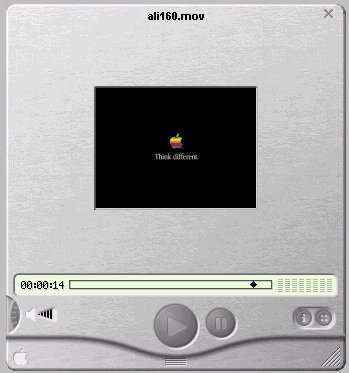
The QuickTime 4.0 Player earned its eternal spot in the User Interface Hall of Shame for its gratuitous skeuomorphism and breathtaking disregard for usability, forcing users to wade through the hollow hubris and masturbatory design indulgences of Apple's avant-garde, artisanal cocaine-snorting 'geniuses' who clearly prioritized looking "cool" in a mirror over making a product anyone could actually use.
>[...] The QuickTime 4.0 Player sports a consumer interface, designed so that it "looks like" a physical consumer product. Apologists for this design philosophy maintain that users will more readily be able to transfer their knowledge of real-world objects to the software. Unfortunately, the apologists fail to recognize that there are two likely consequences of this approach: (1) the user is unable to transfer his or her existing knowledge of computer interaction, and (2) the software becomes needlessly subject to the limitations of the physical device.
>[...] The QuickTime 4.0 player contains many examples of how the software must adopt the limitations of the physical device it is based on, but the first example the user is likely to discover is the volume control. Since a real-world hand-held electronic device typically employs a thumbwheel to control the volume, the designers concluded that it would work just as well in a software application. What the designers failed to realize is that a thumbwheel is designed to be operated by a thumb, not a mouse. Watching new users try to adjust the volume can be a painful experience. The user invariably tries to carefully place the cursor at the bottom of the exposed portion of the control, then drags it to the top of the control and releases, then carefully positions the cursor again at the bottom of the control, drags upward, and well, you get the picture.
I don't use it anymore, but I'm glad VLC got popular and supported everything out of the box. I remember needing to download quicktime and realplayer just to play specific codecs


That was a huge deal, suddenly multimedia interactivity was everywhere's in a way we don't see today. Classics like Myst would probably not have been what they were without QuickTime.
I miss the days of apps that strived to be useful and feature packed for "power users". No one targets power users anymore. It's hard to describe to someone who wasn't there these days, but apps in the 90s and early 2000s were just... more. They strived to be something more. They included many little niche features a handful of people might find useful, and they did come in useful.
Apps today, modern QuickTime included just feel like cut down imitations.